Last updated November 17, 2026


Free written scope consultation - allowances, timeline, and change-order rules on paper before a single trade is scheduled
Driveway & Pavers Troubleshooting in Tustin: Common Problems and How to Fix Them
If your pavers are sinking near the garage apron, the problem almost certainly isn’t the pavers. It’s water channeling under the slab from a downspout or irrigation head within six feet of that edge, and sealing or re-sanding won’t fix it. That’s the pattern we see most in Tustin: homeowners spend on a cosmetic fix for what is really a drainage or base failure. This guide gives you a symptom-to-solution framework, so you can tell which problems a bit of polymeric sand and a rented plate compactor will solve, and which ones require pulling a whole section and rebuilding it.
Quick Answer
Most driveway and paver problems in Tustin trace back to water, base compaction, or edge restraint, not the pavers themselves. Sinking near the garage or street is usually a drainage or soil-compaction issue; white haze (efflorescence) comes from moisture and salts moving through the surface; creeping edges mean the restraint has failed. Repairs range from re-sanding and re-setting a few units to pulling and rebuilding a full section, and the only fix that lasts is the one that addresses the root cause.
Styles & brands we work with
- Kitchen remodeling
- Bathroom remodeling
- Home additions & ADU
- Roofing
- Windows & doors
- Driveway & pavers
- Fence
Table of Contents
- Why Does Water Cause Most Paver Settlement in Tustin?
- How Do You Diagnose Sinking Pavers: Soil, Tree Roots, or a Leak?
- What Causes White Haze (Efflorescence) on Tustin Pavers?
- Why Do Paver Edges Creep and Borders Fail?
- What Do Cracked Borders Versus Field Paver Cracks Tell You?
- DIY or Professional? A Decision Tree for Tustin Homeowners
- How Much Does Paver Repair Cost in Tustin?
- Choosing Pavers That Hold Up in Tustin
Why Does Water Cause Most Paver Settlement in Tustin?
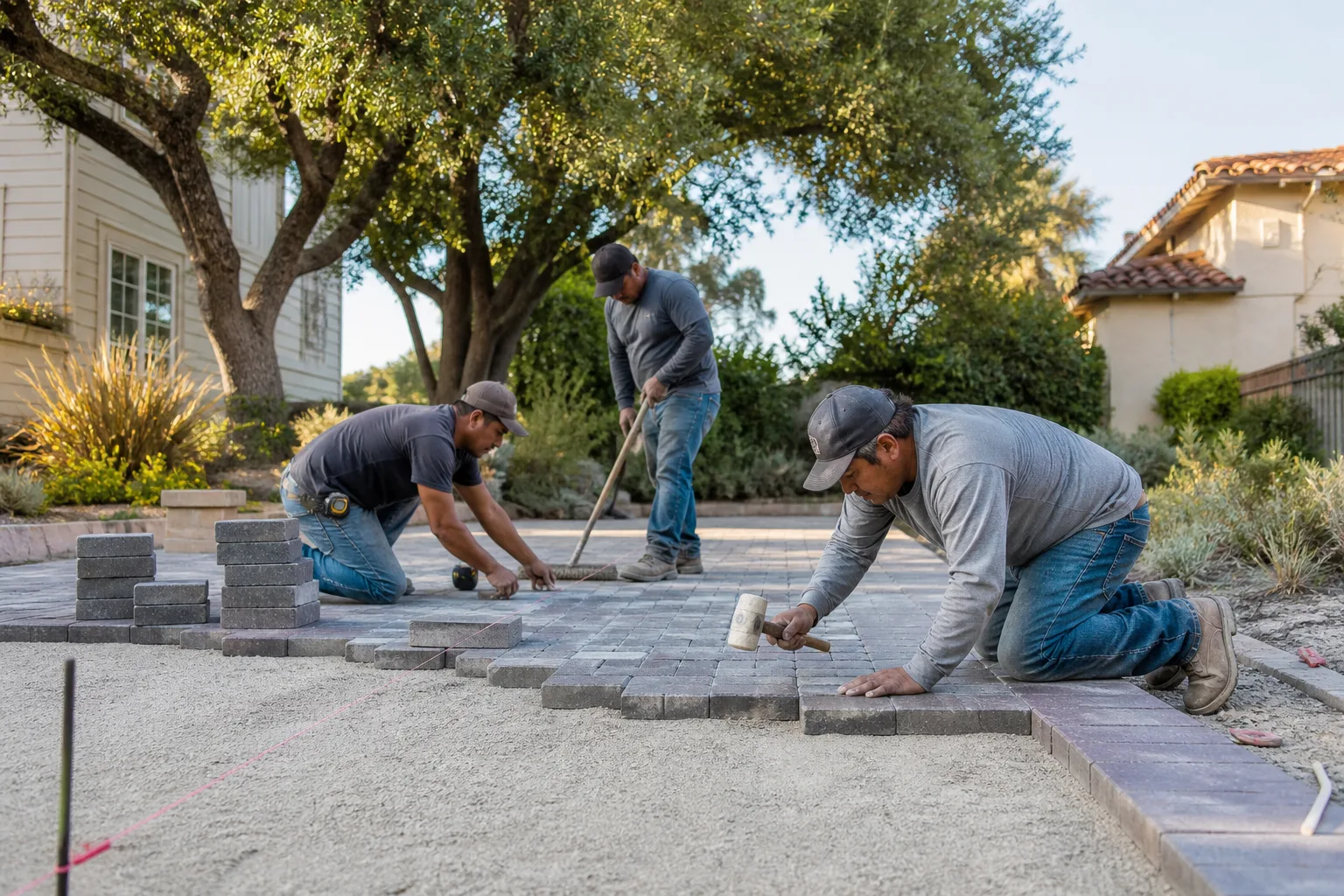
Water is behind the majority of paver failures we’re called to look at in Tustin. A paver system is a layered assembly: the pavers on top, a bedding layer of sand, a compacted aggregate base, and the subgrade soil beneath. When water reaches the base, it softens the subgrade, washes bedding sand out through the joints, and leaves voids. The paver then settles into the void. From above it looks like the paver “failed,” but the paver did its job. The base under it moved.
Tustin’s winters are mild, so settlement here is a water-management story, not a freeze story. The local cycle that matters is the long dry season followed by winter rain. Soil that dries and shrinks for months takes on water fast in the first storms, and if the surface can’t shed it, that water finds the weakest point in the base.
Where the water usually comes from
- Downspouts that discharge onto the driveway. Roof water dumping at the edge of a slab is the single most common culprit.
- Irrigation heads within a few feet of the pavement. A head that oversprays the hardscape wets the same spot day after day.
- Flat or reverse-sloped surfaces. A driveway that ponds instead of draining pushes water down through the joints.
- Failed joint sand. Once the sand between pavers washes out, water has an open path straight into the base.
- Overflow from planters or raised beds that drain toward the driveway instead of away from it.
The fix is to redirect the water first and repair the pavement second. Re-leveling pavers over a base that still takes on water means the same hollows come back the next rainy season. If you want to see how we handle a full rebuild of the layered system, our driveway & pavers page walks through base prep, bedding, and restraint. Getting the water right is the whole game.
How Do You Diagnose Sinking Pavers: Soil, Tree Roots, or a Leak?
Sinking pavers have at least three common root causes in Tustin, and each one needs a different repair. Treating them the same is why some repairs come back within a season. Before anyone quotes a repair, the cause should be identified. Here’s how we sort them.
1. Soil compaction failure
This shows up as a broad, shallow dip affecting a group of pavers rather than a sharp hole. It’s most common near the garage apron and along the driveway’s center where vehicles sit. The base wasn’t compacted in lifts, or the subgrade was soft when it was built, and traffic has slowly pressed it down. Tell-tale signs: the dip is gradual, several pavers move together, and there’s no obvious water source.
2. Tree root intrusion
Roots lift and heave. The signature is a localized hump or a fan-shaped pattern where pavers tilt away from a nearby tree. If you can trace the distortion back toward a mature tree, roots are the likely cause. Sometimes the roots are also stealing moisture and creating voids on the other side. Repair means cutting the offending roots (only with care for the tree) and rebuilding the affected base.
3. Underground irrigation leaks
A slow leak under the driveway is the quiet one. Look for a section that stays damp long after rain, moss or weeds pushing up through joints, or a persistent soft spot. Irrigation lines running under pavement are common. If a line is leaking, no amount of paver work will hold until the line is repaired or rerouted.
Quick check before you call anyone
- Walk the surface after a rain and note where water stands longest.
- Look up: where do the downspouts discharge?
- Turn the irrigation on briefly and watch for heads overspraying the pavement or a section that stays wet.
- Note whether the dip is broad (compaction) or sharp and localized (roots, a broken paver, or a void).
- Check the edges: is the border still tight against the field?
That five-minute walk gives a contractor enough to quote the right repair instead of guessing.
What Causes White Haze (Efflorescence) on Tustin Pavers?
Efflorescence is a white, powdery bloom on the surface of concrete pavers. It’s salt migrating from inside the paver to the surface as moisture moves through it. The salt reaches the surface, the water evaporates, and the salt stays. It’s cosmetic, not structural, but it’s persistent if the moisture source isn’t addressed.
Tustin’s water supply runs alkaline, and alkaline water moving through concrete pavers accelerates the bloom. Combined with irrigation overspray, you get the recurring haze many homeowners fight every summer. Sealing alone doesn’t fix efflorescence. It can trap moisture and make it worse.
The sequence that actually works
- Fix the moisture source. Redirect downspouts, adjust irrigation so heads don’t hit the pavement, and correct ponding.
- Clean the bloom. A dedicated efflorescence cleaner – Techniseal EF Efflorescence Cleaner is the one we specify – dissolves the salt rather than scrubbing it back into the joints.
- Let the pavers dry fully. Sealing damp pavers traps moisture and invites the bloom back.
- Apply a penetrating sealer. A penetrating sealer keeps liquid water out while still letting the paver breathe, which is what stops recurrence. Film-forming sealers are the wrong choice on efflorescing pavers.
Once the moisture is managed and a penetrating sealer is down, most efflorescence stays gone. Keep in mind that new pavers can bloom once after installation too – that’s normal curing, not a defect.
Why Do Paver Edges Creep and Borders Fail?
Pavers are held in place by edge restraint and by interlock. When the restraint fails, the outer course starts to spread or “creep” outward, joints open, and sand washes out. That’s when the whole field starts to move. In Tustin’s clay soils, the wrong restraint fails faster than most homeowners expect.
Why plastic spike-based edging lets you down
Plastic edge restraints held by spikes rely on friction in the soil. In heavy clay that swells when wet and shrinks when dry, spikes work loose season by season. Once the edge moves even a little, the interlock at the border opens up, and the movement works its way inward. You’ll notice it first as wide joints along the outer row.
When to switch to steel or a concrete bond beam
If your edging has already failed once, replacing like-for-like is usually a waste. Two better options:
- Steel edge restraint anchored with longer stakes into stable ground – a solid upgrade for straight runs and curves.
- Concrete bond beam poured along the perimeter – the most durable choice where the driveway meets lawn, planters, or a slope, and the right answer where the subgrade is clay-heavy.
If the border has already spread significantly, the fix is to pull the affected field, re-establish the restraint, and re-lay – not just to tap pavers back into line. That’s the difference between a repair that holds through several wet seasons and one that fails by the next.
What Do Cracked Borders Versus Field Paver Cracks Tell You?
A crack’s location tells you what failed. A cracked soldier-course border (the row of pavers set perpendicular along the edge) usually points to edge or substrate movement. Cracks running through the field, especially along a line, usually point to base movement underneath. A broken paver here and there can simply be overload or a defective unit. Learning to read the pattern saves you from repairing the wrong thing.
What each pattern means
- Cracked soldier course: edge restraint has moved or the base under the border has settled. The border is the first thing to take the stress.
- Cracks along a straight line across the field: a base defect – a seam, a compaction break, or a buried utility trench that has settled.
- Spider cracks fanning from a point: point loading, often a vehicle tire sitting on an unsupported spot or a paver with a weak base beneath it.
- A single cracked paver: often an overload event (a heavy truck, a dropped object) or a defective unit. Replacing the paver is the fix.
A word on temperature
Tustin rarely sees freeze-thaw cycles, so that’s not the main story here. But during cold snaps, concrete pavers can contract and expand slightly, and existing stress points can open into visible cracks. If a crack appears after a cold spell and the border is also loose, treat it as a structural signal, not just a cosmetic one. Vehicle tire pressure and heavy loads are the more common trigger for fanned cracks. If cracks are spreading, that’s the point to stop patching and get the assembly assessed.
DIY or Professional? A Decision Tree for Tustin Homeowners
Some paver problems are straightforward to tackle yourself. Others are the kind of repair where a mistake costs more than the job would have. Use the list of tool sizes and small fixes below against the symptoms above, and be honest about which category you’re in. A few paver problems are honest Sunday repairs.
Safe for a confident DIYer
- Re-sanding joints with polymeric sand where the pavers are otherwise stable and level.
- Replacing a single cracked or chipped paver that isn’t part of a moving section.
- Cleaning mild surface stains with the right product for the paver type.
- Redirecting a downspout so roof water discharges away from the driveway.
Better handled by a professional
- Any section that has settled or heaved. The base needs to be rebuilt, not patched over.
- Edge restraint failure that requires pulling the border and re-establishing steel or concrete restraint.
- Suspected irrigation leaks under the pavement. Diagnosing and rerouting those lines is a job in itself.
- Widespread or spreading cracks that point to a base defect.
- Full driveways worth of efflorescence that keeps returning after cleaning.
A decision tree in plain language
- Is the pavers’ surface simply dirty or missing joint sand? Re-sand and clean.
- Are one or two pavers broken but the surface around them flat? Replace the pavers.
- Is a broad area dipping? That’s base failure. Get it rebuilt.
- Are the outer edges spreading? Get the restraint replaced with steel or a bond beam.
- Are joints opening and a section staying wet? Find the water source before anything else.
- Does more than one of these apply? Get a written estimate on the whole section, not piecemeal patches.
If you use polymeric sand, follow the manufacturer’s curing instructions carefully. Too much water during installation ruins it, and too little leaves it never setting.
How Much Does Paver Repair Cost in Tustin?
Paver repair in Tustin is quoted per job once the cause is identified, because the repair differs so much from case to case. A spot repair where a paver or two is reset is at the low end; pulling a whole section, rebuilding the base, and re-laying is at the high end. Below are typical ranges to orient you. They are estimates only, and the written line-item estimate sets the final price. Estimates are free.
| Repair type | Typical estimated range |
|---|---|
| Re-sand joints with polymeric sand (per section) | $150 – $500 |
| Replace or reset a few individual pavers | $200 – $600 |
| Spot repair: pull and re-lay a small settled area | $400 – $1,200 |
| Rebuild a section including base remediation | $900 – $2,500+ |
| Edge restraint upgrade to steel or concrete bond beam | $30 – $80 per linear foot |
| Efflorescence cleaning and penetrating sealer | $300 – $900 |
Prices move based on access, the size of the area, and whether the base needs full replacement or partial. A written estimate keeps this transparent and, with us, fixed – no change orders blindsiding you once work is underway. Call (844) 415-6046 for an exact quote. Estimates are free.
Choosing Pavers That Hold Up in Tustin
The right paver in the right place makes the assembly easier to keep healthy. For Tustin driveways, we work with Belgard, Unilock, Techo-Bloc, Cambridge Pavers, and Tremron, which gives you real selections from which to actually build your driveway. Manufacturer warranties generally outperform anything a generic concrete pour can support.
What to weigh
- Thickness and density: driveway-rated pavers should be thick enough for vehicle loads; skimping here is one of the most common errors.
- Joint design and interlock: good interlock keeps the field tight under tire pressure.
- Ease of maintenance: some textures and finishes hide efflorescence or tire marks better than others.
- Restraint matching: the paver system only performs as well as its edge restraint and base.
A paver laid on a poor base will fail no matter how good it is, and a good paver on a correct base will last. That’s why our estimate always covers the base and edge, not just the surface.
Common Mistakes to Avoid
- Sealing over fresh efflorescence. Sealing a blooming paver traps the moisture and locks the haze in. Clean, dry, then seal.
- Re-sanding without finding the water source. New sand washes out the same joints if a downspout or irrigation head is still pouring water onto the pavement.
- Replacing plastic edge spikes with the same thing. If the restraint already failed, it will fail again. Move up to steel or a concrete bond beam.
- Patching a reverse-sloped driveway. Adding pavers on top of a ponding surface changes the look, not the drainage; the water still has to go somewhere.
- Diagnosing a drip as “just settling.” A section that stays damp between rains is likely an irrigation leak under the slab. Fix the line before rebuilding.
- Skipping a written estimate. “We’ll figure it out as we go” is how paver repairs spiral. Get the scope and the price in writing before anyone starts.
See the difference
 Before
 After
 Before
 After
 Before
 After
When to Call a Professional
Call a professional when the symptom is structural, not cosmetic. That means any section that has settled, heaved, or spread; any dip broad enough to trap water; any suspected irrigation leak under the pavement; any edge restraint that has failed or borders that are cracking; and any crack pattern that spreads. These are the repairs where the wrong approach buys you a season and a second repair. Expert diagnosis is what separates a fix that lasts from a delay. Construction Tustin offers free estimates in Tustin. Call (844) 415-6046. We answer 24/7, and we dispatch from 7am to 7pm, Sunday through Friday.
Frequently Asked Questions
Typical repairs in Tustin fall between a few hundred dollars for a spot fix and roughly $2,500 or more for rebuilding a section with base remediation. Edge restraint upgrades run per linear foot, and cleaning and sealing is a separate line item. Exact numbers depend on the cause and the area. Call (844) 415-6046 for an exact quote – estimates are free.
You can re-sand yourself if the pavers are stable and level and the only issue is missing joint sand. If the section is also settling or a downspout is washing the joints out, re-sanding alone will not hold. Get the cause diagnosed first, then decide.
A repair that fixes the root cause – water, base, or restraint – typically holds through many seasons. A repair that only addresses the surface, such as re-sanding over a failing base, can fail in the next rainy season. The estimate should say clearly which cause is being treated.
No, not with us. We confirm the scope and the price in a written line-item estimate before work begins, and that price is fixed. If the discovery process shows the base is worse than expected, we pause, explain what changed, and get approval before proceeding – no surprises at the end.
Most paver repairs are maintenance work that does not require a permit, but new driveways or major changes to drainage and grade sometimes do. Ask your city’s building department to confirm, and we’ll adapt the scope accordingly. Call (844) 415-6046 if you’d like us to factor permits into your estimate.
We are closed Saturday, and open Sunday through Friday, 7am to 7pm. If something gives way over the weekend, call and we’ll book you into the next opening. We answer 24/7, so a call outside dispatch hours is booked into the next slot. Call (844) 415-6046.
The Bottom Line
Nearly every driveway and paver problem in Tustin comes back to water, base compaction, or edge restraint, and diagnosing the right one is what makes a repair last. White efflorescence, sinking sections, and creeping borders are symptoms, not the disease. Some fixes – joint sand, single pavers – are fair DIY work. Others require pulling a whole section and rebuilding the base. The estimate should name the cause and the fix, in writing and at a fixed price. When you’re ready to have it assessed, Construction Tustin offers free estimates in Tustin. Call (844) 415-6046. We answer 24/7, with fast dispatch from 7am to 7pm.
If you’re weighing the bigger picture and want one contractor who can handle a hardscape project alongside fencing, an addition, or a roof refresh, our Construction Tustin page lays out the seven service categories. For the finishing touches around a driveway rebuild, our fence installation page covers materials from Barrette and Master Halco, and our home additions & ADU page explains how we approach larger builds on the same property.
Written by the team at Construction Tustin.